#include <stdio.h>#include <stdlib.h>#include <sstream>#include "leveldb/env.h"#include "leveldb/slice.h"#include "util/random.h"
Include dependency graph for testharness.h:
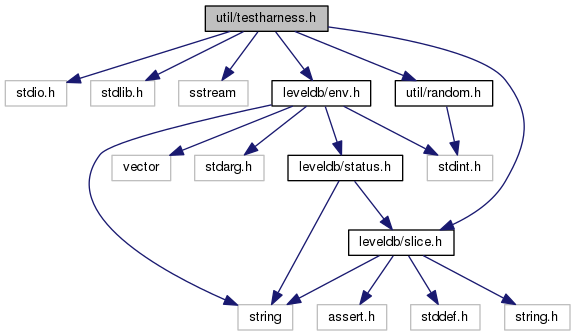
This graph shows which files directly or indirectly include this file:

Go to the source code of this file.
Classes | |
| class | leveldb::test::Tester |
Namespaces | |
| leveldb | |
| leveldb::test | |
Macros | |
| #define | BINARY_OP(name, op) |
| #define | ASSERT_TRUE(c) ::leveldb::test::Tester(__FILE__, __LINE__).Is((c), #c) |
| #define | ASSERT_OK(s) ::leveldb::test::Tester(__FILE__, __LINE__).IsOk((s)) |
| #define | ASSERT_EQ(a, b) ::leveldb::test::Tester(__FILE__, __LINE__).IsEq((a),(b)) |
| #define | ASSERT_NE(a, b) ::leveldb::test::Tester(__FILE__, __LINE__).IsNe((a),(b)) |
| #define | ASSERT_GE(a, b) ::leveldb::test::Tester(__FILE__, __LINE__).IsGe((a),(b)) |
| #define | ASSERT_GT(a, b) ::leveldb::test::Tester(__FILE__, __LINE__).IsGt((a),(b)) |
| #define | ASSERT_LE(a, b) ::leveldb::test::Tester(__FILE__, __LINE__).IsLe((a),(b)) |
| #define | ASSERT_LT(a, b) ::leveldb::test::Tester(__FILE__, __LINE__).IsLt((a),(b)) |
| #define | TCONCAT(a, b) TCONCAT1(a,b) |
| #define | TCONCAT1(a, b) a##b |
| #define | TEST(base, name) |
Functions | |
| int | leveldb::test::RunAllTests () |
| std::string | leveldb::test::TmpDir () |
| int | leveldb::test::RandomSeed () |
| bool | leveldb::test::RegisterTest (const char *base, const char *name, void(*func)()) |
Macro Definition Documentation
§ ASSERT_EQ
| #define ASSERT_EQ | ( | a, | |
| b | |||
| ) | ::leveldb::test::Tester(__FILE__, __LINE__).IsEq((a),(b)) |
Definition at line 107 of file testharness.h.
§ ASSERT_GE
| #define ASSERT_GE | ( | a, | |
| b | |||
| ) | ::leveldb::test::Tester(__FILE__, __LINE__).IsGe((a),(b)) |
Definition at line 109 of file testharness.h.
§ ASSERT_GT
| #define ASSERT_GT | ( | a, | |
| b | |||
| ) | ::leveldb::test::Tester(__FILE__, __LINE__).IsGt((a),(b)) |
Definition at line 110 of file testharness.h.
§ ASSERT_LE
| #define ASSERT_LE | ( | a, | |
| b | |||
| ) | ::leveldb::test::Tester(__FILE__, __LINE__).IsLe((a),(b)) |
Definition at line 111 of file testharness.h.
§ ASSERT_LT
| #define ASSERT_LT | ( | a, | |
| b | |||
| ) | ::leveldb::test::Tester(__FILE__, __LINE__).IsLt((a),(b)) |
Definition at line 112 of file testharness.h.
§ ASSERT_NE
| #define ASSERT_NE | ( | a, | |
| b | |||
| ) | ::leveldb::test::Tester(__FILE__, __LINE__).IsNe((a),(b)) |
Definition at line 108 of file testharness.h.
§ ASSERT_OK
| #define ASSERT_OK | ( | s | ) | ::leveldb::test::Tester(__FILE__, __LINE__).IsOk((s)) |
Definition at line 106 of file testharness.h.
§ ASSERT_TRUE
| #define ASSERT_TRUE | ( | c | ) | ::leveldb::test::Tester(__FILE__, __LINE__).Is((c), #c) |
Definition at line 105 of file testharness.h.
§ BINARY_OP
| #define BINARY_OP | ( | name, | |
| op | |||
| ) |
Value:
template <class X, class Y> \
Tester& name(const X& x, const Y& y) { \
if (! (x op y)) { \
ss_ << " failed: " << x << (" " #op " ") << y; \
ok_ = false; \
} \
return *this; \
}
Definition at line 77 of file testharness.h.
§ TCONCAT
| #define TCONCAT | ( | a, | |
| b | |||
| ) | TCONCAT1(a,b) |
Definition at line 114 of file testharness.h.
§ TCONCAT1
| #define TCONCAT1 | ( | a, | |
| b | |||
| ) | a##b |
Definition at line 115 of file testharness.h.
§ TEST
| #define TEST | ( | base, | |
| name | |||
| ) |
Value:
public: \
void _Run(); \
static void _RunIt() { \
TCONCAT(_Test_,name) t; \
t._Run(); \
} \
}; \
bool TCONCAT(_Test_ignored_,name) = \
void TCONCAT(_Test_,name)::_Run()
Definition: autocompact_test.cc:11
bool RegisterTest(const char *base, const char *name, void(*func)())
Definition: testharness.cc:24
Definition at line 117 of file testharness.h.